“Blessed are the men and women
who are planted on your earth, in your garden,
who grow as your trees and flowers grow,
who transform their darkness to light.
Their roots plunge into darkness;
Their faces turn toward the light…”
King Solomon
—–
A few musings on winter…
I was at work one morning, a couple of weeks ago. Part of my day involved driving a van from Galway down to Scarriff, in Co. Clare.
This is a beautiful journey, even on a damp November day.
During the drive, there and back, I had plenty of time to let my mind ramble.
I got to thinking about winter.
Winter, for me, kicked in sometime in mid-November. I got up one morning and just felt it in me waters, I felt it in my bones… “Ah, winter’s here.”
It was a struggle to get out of bed. The alarm went off and I had a few thoughts of… “Just let me sleep… wake me up in March…”
Living, as I do, in the West of Ireland, the seasons are not so clearly defined. You can get a sunny day in April that will beat many days in so-called ‘summer’. On the flip side, you can get snow in April, while there may not have been any snow in so-called ‘winter’.
A lot of the days in Galway are very similar, no matter what time of year.
They often have a damp, cloudy quality to them, with a temperature hovering around the low to mid-teens (°C).
Sometimes, you would be hard pressed to know if it was a day in March or a day in September.
Most likely, it’s about to rain, has just rained or is currently raining.
You then have a roll of the dice most mornings as to whether there will be a gale force wind, some hailstones, or if the sun will be splitting the rocks.
Over the course of a couple of months though, you will get some sense of the season.
A general vibe.
Winter… well, winter is hard work I find.
There are no leaves on the trees. There are a lot of storms, rain, wind… and oh God… the darkness…
Dark at 8:30am. Dark at 4:30pm. Some days you might not see the sun at all.
It’s no joke.
Anyway, I like this description of Ireland’s climate, from Malachi O’Doherty’s book ‘Can Ireland Be One?’
“Ireland sits between climate zones and seems positioned by geography to be a point of division, a boundary or perhaps a connection. We huddle against storms that would daunt the Inuit and bask in occasional Mediterranean Summers. We have palm trees on the western coast. Schools close for snow and occasionally the tarmac melts in the summer, so reconciling ourselves to extremes should be in our nature. It isn’t. We call this climate temperate or moderate. It is, in fact, bi-polar.”
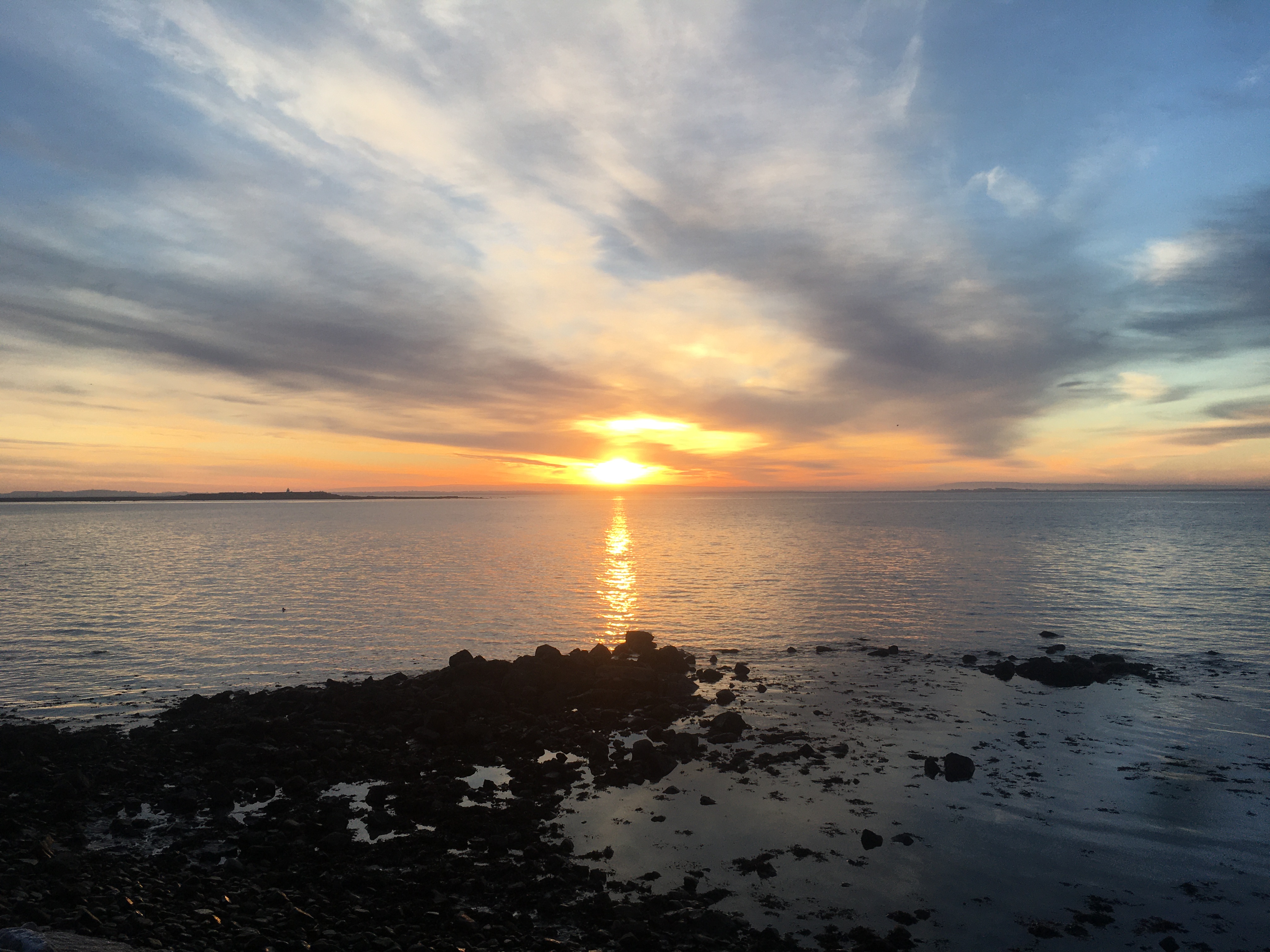
Ériu, Banba and Fódla.
A long, long time ago… a group of people arrived in Ireland called the Milesians. The Sons of Míl. They possibly came up from Galicia, in Spain, and their arrival was apparently the beginning of Celtic Ireland. When they landed, they encountered a people already living here called the Tuath De Dannann.
The Tuath De Dannann are associated with many underground places and entrances to underworld places in Ireland.
Among the Tuath De Dannann were three sisters/princesses/goddesses called Ériu, Banba and Fódla. A kind of threefold entity that represented sovereignty over the island.
One of the Sons of Míl was a man called Amergin. He was a poet and a Druid. He is also responsible for the astonishing ‘Song of Amergin’. An incantation with the power to calm a storm.
After much fighting and loss of life for both the Milesians and the Tuath De Dannann, the three sisters agreed to let the Milesians settle the island. They did this on the condition that Amergin named the island after each of them. He met them, individually, on his way to the Hill of Tara and granted each their wish.
Thus, Ireland has three names from this era. Ériu, Banba and Fódla.
I’m a huge fan of the writer and philosopher John Moriarty, and if you enjoy having your mind melted, I highly recommend checking out his books.
He imagines how each of these three names represent different aspects of this land. Different ways of experiencing, different ways of being, different headspaces you might find yourself in. He likened Ériu to the more official ‘day-to-day’ version of Ireland.
Fódla and Banba might represent more poetic or dreamlike aspects to Ireland…
Anyway, it is Ériu that we are most familiar with today. She is a huge figure in Irish mythology, often representing the richness, abundance and fertility of the land. She has given us the modern names Éire, Erin, Éireann and Ireland… or Ériu-land.
The Romans called Ireland – ‘Hibernia’. This may have come from a Greek version of this Ériu name, Iouernia or Iovernia, taking on some of her qualities and most likely meaning ‘Abundant Land’.
The Romans found a similarity with the Latin word ‘hibernus’, meaning ‘wintry’, and called the island ‘Hibernia’. The dark place. The wintry place.
We still use this name today, in ‘Hiberno-English’ and such.
Hibernia is related to the verb ‘to hibernate’. Which means ‘to winter’.
Bon Hiber.
Ireland can certainly have some of the dark, sleepy characteristics of these words. It’s not the whole story, but there’s a fair bit of truth there…
Agua Profundo.
I find Eastern philosophy very interesting. The Chinese have a system of understanding the world called ‘Five Elements’ or ‘Five phases’. This system shows up in many areas of Chinese culture, martial arts, acupuncture etc. It is a very comprehensive system and it is an interesting way of looking at how different subjects may interrelate with each other.
There are five different elements in this system, Earth, Metal, Water, Wood and Fire. These elements interact with each other in different ways. They might be supportive, destructive, nourishing or controlling. There’s a nice cyclicality to the whole thing.
The elements can be associated with different times of the year, different parts of the body, different foods, different feelings. It really is a beautiful system, and it’s a fun challenge for my “Western” mind to contemplate.
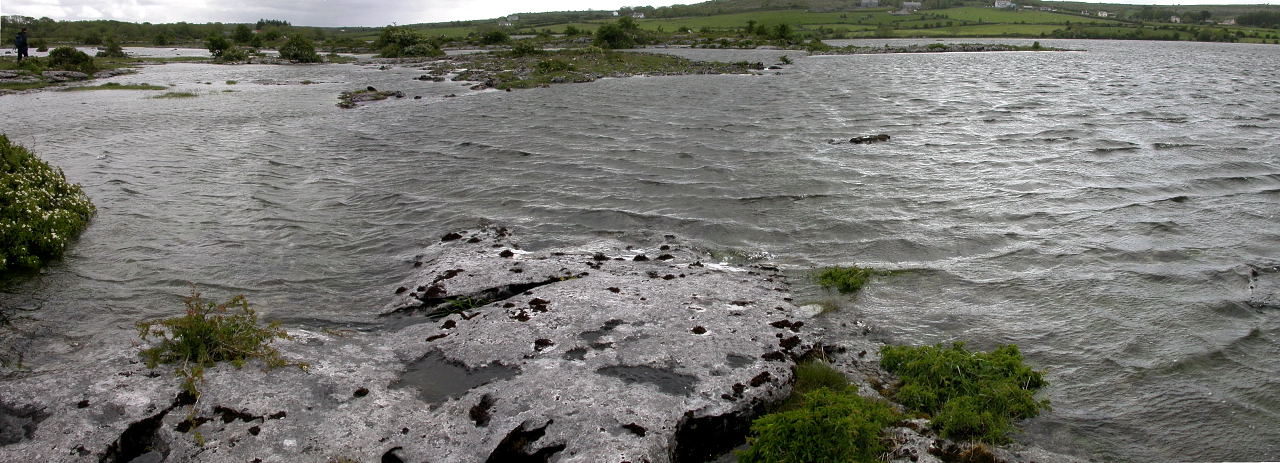
In this system, the Water element is associated with winter. This time of year water, and it’s energy, flows down and pools and gathers.
“In winter, the season of Water, the Ki of nature withdraws to deep within the earth, to rest and regenerate before the outward thrust of spring”
Carola Beresford-Cooke
I somehow understood this a little bit better as I drove through South Galway and East Clare that day. As I drove, I observed how the water ‘pools’ in the low parts of fields and comes up through the ground, as the water table rises, to create little lakes and turloughs. The rivers, lakes and streams were swollen with water.
This is a limestone area, where there are vast caverns and cave complexes. Water disappears and flows underground, reappearing somewhere else.
There is a place, just outside the town of Gort, that I really enjoy visiting. It is a section of the Gort/Beagh River with parts known variously as the ‘Devil’s Punchbowl’, ‘the Basins’, ‘the Ladle’ and ‘the Churn.’
The river disappears under hills, re-emerges in huge amphitheatre-like ‘bowls’, disappears, reappears, circles around a swallow hole then disappears again for miles, emerging somewhere on the coast near Kinvara.
This part of the world is very much associated with those Tuath De Danann mentioned earlier.
One of the associations of the Water element is the subconscious and the unconscious. The dark caverns and subterranean realms of the mind.
It’s interesting to think of the water flowing through all of those underground places.
The area is known for its artists. It was from here that Lady Gregory and W.B. Yeats had a huge impact on Irish society and culture. A place of poets and writers, music, folklore and healers.
The writer, Jackie Queally, has a lovely book called ‘Spirit of the Burren’ which explores this area through the five element system. That book was definitely in my thoughts as I was contemplating all this.
Bare Necessities.
In Chinese medicine, the Water element is associated with the Bladder and Kidneys. Our waterworks. This also relates to our ability to store energy.
It is also associated with the bones, the ears (which have little bones), the subconscious and the autonomic nervous system.
It has a lot to do with our will to survive.
The autonomic nervous system regulates our heart rate, our breathing, our digestion, our sexual arousal and our blood pressure. All stuff that’s essential for our (or our species) survival. It does this autonomously and will keep us going even when we’re unconscious.
In the winter season, the essentials are important.
Life gets stripped back to the bare necessities.
The leaves are gone from the trees.
The animals are hibernating.
It is a time for energy conservation.
A time of minimal activity.
Just whatever is needed to keep life ticking over until the spring comes.
As animals hibernate, their breathing slows, as does their digestion, they have a low metabolic rate and their body temperature drops. I’m sure this process is active in us humans on some level too.
As well as the storms and rain, winter can also be pretty quiet, pretty ‘chill’.
When everything is covered in snow, there is a hushed quietness that can make it feel like the whole place is asleep.
There goes the fear.
The Chinese associate the emotion ‘fear’ with the Water element. In this article, geneticist Gerard Karsenty of Columbia University discusses his research on the relationship between fear and our bones. It is interesting that the Chinese should have observed this relationship thousands of years ago.
The ears and the sense of hearing are also associated with fear. Our ears are highly attuned to sense danger.
Anyway, I started thinking about all of this the other day, after a conversation with a friend of mine. They had just lost their job and were understandably, and justifiably, feeling a lot of fear.
This is one of the major fears of winter. The fear of not having enough resources to get us through. Have we stored enough from the year to see us through until spring, when the sun shines and everything starts growing again?
Will we be able to survive? What will become of us?
I think this fear is very well expressed in the last verse of Gillian Welch’s song “I Dream a Highway”.
“What will sustain us through the winter?
Where did last year’s lessons go?
Walk me out into the rain and snow.
I’ll dream a highway back to you.”
While not particularly about winter, the song captures some of the heavier aspects of this dark and barren time of year.
It seems lonesome and desolate. There are wintry colours of blue and porcelain white.
I don’t know if it’s just how I hear it, but it seems to slow down at times. Like it’s dragging.
It seems almost outside of time, frozen somehow.
At the same time, it also feels very intimate, like you’re sitting in beside them. A deep and meaningful fireside jam with Gillian and Dave as they knit and weave guitars and voices together…
David Gray’s “Nightblindness” also comes to mind. It too captures this fearful, resource worry, aspect of winter.
“What we gonna do
when the money runs out?
I wish that there was somethin’ I could say.
How we goin’ to find the eyes to see
a brighter day?”
As I remember, this was David Gray’s last roll of the dice on his music career… He was dropped by his record company and had been talking with his wife about becoming an estate agent!
He decided to record ‘White Ladder’ at home. It went on to become his most successful album. Just when the days were at their darkest and he was about to give up…
I like this story. There’s a bit of the will to survive, the will to keep going, that is another characteristic of the Water element.

Oiche Gaillimheach by John Mulhern
I winter, you winter…
So, back to hibernating.
This verb – ‘to winter’. How well do we hibernate? How well do we winter? Do we do it with style and ease, or are we like Bambi on ice?
If you’re one of those people who sails through winter on a cool breeze, then good for you.
I definitely struggle at times.
I like to think I’m getting a little better at it, as the years go by.
There are a few things I need to remind myself of when wintering.
A few observations and maybe a bit of a rant…
Resource Management.
I really enjoy foraging. I can’t claim to be any sort of expert, and I don’t do it as often as I would like, but it is something I enjoy.
It’s a great way to get in touch with nature, to get out and about walking. To tune into the seasons and get some sense of the cyclical nature of time as each season rolls around.
This year, I had a great autumn. I found loads of hazelnuts, picked plenty of mushrooms, some berries and was lucky to be given lots of delicious apples.
I’d love to make a tincture of hawthorn, it’s good for the heart apparently, but it requires a bit of planning.
Maybe next year.
I find that each year I have a little more knowledge about the natural world around me than the last. Getting out and about in nature is good for me, gets fresh air into my lungs, sun on my face, it grounds me a bit.
It can be hard in winter though. It’s dark when I’m going to work and it’s dark when I get home. Sometimes it rains for days, and the will is low. I do my best. Every bit of sunshine is precious.
It’s a real joy when we get a clear, frosty, winter day. It’s so nice to walk a quiet country road, fields and trees covered in shimmering white. A hush and a beauty that can take your breath away. A piebald horse or a moon-white cow with their head in over a stone wall. Turning the air foggy with their breath.
A beautiful scene. Not great for foraging though. Slim pickings. My autumn bounty was great, but I’d be fooling myself if I thought it would sustain me through the winter. It is long gone. Ate.
Luckily there is a supermarket down the road, where I can buy my hazelnuts…
Most of us are at least somewhat removed from the food chain and the process of growing, cultivating, hunting, fishing and storing food. Our relationship with these things is much less direct than it was in previous generations.
There is a similar disconnect with where our fuel and heating comes from. Not many of us are saving turf or chopping up wood to see us through the cold months.
We order 500L of kerosene or turn on the storage heater instead.
We mostly pay for these goods with money earned from our jobs, from pensions, or unemployment and child support.
While times have changed, the same rules still apply. If you haven’t put aside enough during the year, you may go hungry and cold. Or at least hungrier and colder.
I’ve been getting better with managing my finances. Often, I’d end up running on fumes this time of year. I’m managing to store the funds a bit better for when the lean months come.
I’m lucky to have more money coming in than going out at the moment.
It’s tricky though. There has been huge inflation the last couple of years. This has hit families, as the cost of food and other items have increased.
There is also a housing crisis here.
The rent is too damn high!
All of this makes the provision of the essentials – food, warmth and shelter a little more difficult for everyone. This is the time of year when we generally feel it the most.
Ho Ho Ho.
It’s also the time of year when we are very much encouraged to ‘Spend it like Beckham’.
Smack bang in the middle of winter comes Christmas. A religious festival which has become a several-month-long, consumption based, mega-event.
It’s very difficult to avoid the advertising and the social pressure to just buy loads of stuff that you or your loved ones don’t need. At a time of the year when we all could do with conserving our energy/money, we are letting it spill out of our pockets!
Gift giving is a beautiful thing, but people are maxing out credit cards and taking out loans for present buying.
A woman I know spent €1200 on her son’s presents last year. It seems like €250 – €300 per child is pretty average.
The Irish Times had a figure of around €2300 for a ‘family of four’ Christmas spend.
Irish families spend twice as much as the EU average. It’s a big chunk of change for most people to come up with at this time of year. A lot of people are putting a lot of stress on themselves to not let their kids down at Christmas.
I read an article somewhere… I can’t find it… but as I remember it was from a German university.
They had a study which showed that giving too many gifts to a child made them feel stressed. After the third present the child would begin to feel overwhelmed and anxious.
There is a great song by Greg Brown called “If You Don’t Get It At Home”.
“Children they don’t need a lot of stuff.
Children they sure need a lot of love.
They need love to give them pride.
To make them feel real good inside.
If they don’t get it at home they’re going to go looking”
We could all probably do with turning the dial down a bit on the Christmas madness. Maybe dial it back 20 – 30%.
Stick to the essentials. Good food, good company, games, music, winter walks. Or maybe just a good book and some quiet time.
Give yourself permission to opt out. Stay away from all the Black Friday nonsense! 🙂

Many people’s Christmas’ can end up a long way from the perfect, ‘Marks & Spencer’/’Coca Cola’ ad version we’re sold.
It can be a difficult time of year. The Pogue’s – ‘Fairytale of New York’ captures this very well. A warring couple working their way through hope, disappointment, love, resentment and rage. The realism of the song is a big reason for its popularity. Christmas is not all sweetness and light.
You might end up spending a lot of time with family. Maybe you don’t usually spend that much time together. Maybe you do each other’s head in?
Maybe there’s a lot of pressure on each other to make it ‘The Best Christmas… Ever!’.
Cut yourself some slack and do the best you can, make your excuses if needs be.
At the extreme end of things, hopefully you are not in an abusive situation.
If you are, do your best to remove yourself and get some help and support. My heart goes out to anyone, young or old, in this situation.
Hopefully your festive period is filled with warmth and good cheer. A time to celebrate that you are here, making it through the darkest time of the year, supporting and being supported by your loved ones.
12 Pubs… (note to self…)
So, winter is cold and dark, there is much less life and energy around in general. All around us nature is slowing down. Getting down to the bare necessities. The essentials. Only what is needed to survive. The animals are hibernating. Our bodies are telling us to slow down too.
But… it’s a social time of year.
There are Christmas Parties, work nights out, family gatherings, friends home from Canada or wherever… 12 Pubs!!
There’s even ‘snow’. The expensive kind. The kind you wouldn’t want the kids playing in.
All sorts of distractions that will keep you away from getting to bed early and give your liver extra work to do, at a time of year when it really wants to be doing less.
It’s very easy to run down the batteries over the festive season.
There’s a lot of social pressure to be out and about.
Do what you can, but it’s fine to lay off the sauce too.
Ideally, social gatherings should be small, intimate affairs at this time of year. Dinner shared with friends, that sort of thing.
Drinks should be served warm with cloves and lemon… preferably by the fireside!
It’s good to have a night out now and then but otherwise, just go to bed. It’s cold and dark, you’re tired. Go to bed.
Turn your screen off and curl up with a good book or go to sleep. If you have someone to snuggle up with, all the better, it’s a good excuse to head to bed early!
Less shots at the bar, more fireside chats, writing, playing music, knitting, whatever your interests are.
Winter is a time for artistic pursuits, philosophizing, reflecting on the year, scarves and gloves, frosty morning walks, nice warm cups of tea… save your ‘3-day-party’ energy for the summer!
The balance between full on, energy intensive, socializing and quiet, introspective, alone time is one that I have always struggled with. I’ll keep working on it though.
While it’s important to have quiet time, too much can be isolating.
Humans are among the most social creatures on the planet. Hard wired into our survival is our ability to cooperate well with others. Hopefully we have managed to nurture our important relationships during the year and can share the things we’ve gathered and learned.
I feel it through my shoes… they used to call it the blues…
People deal with their winter depression in different ways. By getting out for morning walks, going for daily dips in the sea, taking herbs, using SAD lamps/light therapy, checking in with friends, meditation, lying in bed, heading away to the Canary Islands (if they can)… whatever works.
A very good friend of mine is a wonderful gardener. From September to November, she enjoys planting spring-flowering bulbs. Daffodils, tulips and everything else.
She tells me that she takes great comfort knowing that they are out there growing in the soil.
It helps her through the winter knowing they are there in the stillness, gathering their power, ready to emerge in the Spring.
Knowing this brings me a little comfort too!
Home is where the hearth is.
There is something lovely about lighting a fire. It is heartening, and it seems to have a value beyond just heat and light.
There was a tradition in this part of the world of neighbours keeping a fire lit while the owners of a house were away. A person might have a cottage in Connemara but be away working in London or Boston. A neighbour would light a small fire everyday while they were gone.
As well as keeping the damp at bay, it was also thought to keep the heart and soul of the house going.
This also reminds me of an article I once read about a tribe in the Northern Territory of Australia. They would go on ‘Walkabout’ in the vast open land. They had a very slow burning plant/moss that allowed them to carry the smouldering embers of their fire with them. When they were done with their day’s walking, they would pick a spot then restart their fire with whatever fuel was around them. Once they had their fire going, they were ‘at home’. It didn’t matter where they were in the vastness, they were at home when the fire was lit.
Home is where the hearth is.
It is a pleasure to light a fire on a cold winter’s evening, wrap a blanket around yourself, get cosy. Enjoy some good company. Maybe with a cup or glass of a warm beverage. Perhaps a bit of music…
A neighbour of mine sadly lost her husband, several years ago.
I had a conversation with her shortly afterwards. She spoke of how she missed him and of their time together. One thing she emphasised was that it wasn’t just the big occasions of life that seemed important. She recalled the many nights they spent sitting by the fire.
“Maybe he was reading, maybe I was knitting… maybe the radio was on. We were content with each other’s company.”
In the telling, these nights seemed weighted with just as much importance as ‘once in a lifetime’ holidays or the arrival of grandchildren.
I thought this was beautiful, and it seems to speak a little of the essentials. The stuff of life.
Grianstad
In the east of Ireland, in Co. Meath, there is a site of international significance. It is called Brú Na Bóinne.
A beautiful, feminine landscape of gentle, rolling hills on the banks of the meandering River Boyne.
The area is also associated with those Thuath De Dannann people, and contains many monuments, passage tombs, burial mounds and standing stones, along with beautiful megalithic artwork.
Brú Na Bóinne and the River Boyne get their name from Boann, another DeDannann deity. A river goddess. A water goddess. The name Boann is interpreted as ‘white cow’. Milk-white or moon-white.
It also relates to ‘bainne’ or milk.
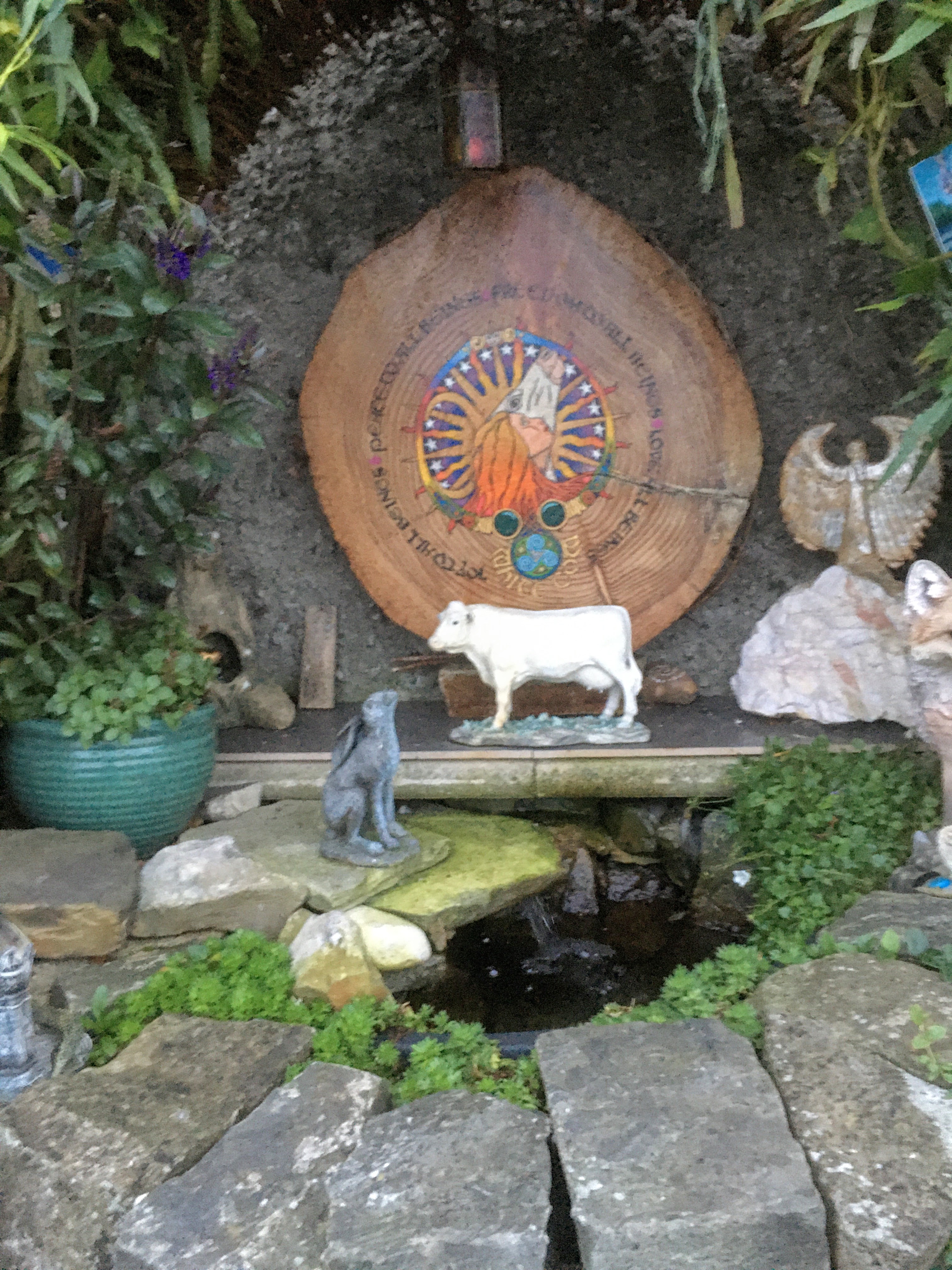
While I’m at it, here’s an excerpt from John Moriarty’s ‘Invoking Ireland’. I’ve taken it completely out of context, but anyway, I’m including it here to remind myself to read the book again and also to maybe pique your interest. This part comes from a chapter called Ollamh Fódhla.
“Here, as well as being a moon-white cow, the goddess is Boann, the gleaming river.“
“Boann, the moon-white cow.
Boann, the gleaming river.
In dreams I know it as cow.
Awake I know it as river.”
Boann, among other things, is associated with the power of life and rebirth.
Probably the most significant monument in the Brú Na Bóinne complex is the Neolithic passage tomb of Newgrange. It is a 5000-year-old archaeological and astronomical marvel. A gigantic marker of cyclical time.
The passage is precisely aligned so that each year on the 21st of December, the winter solstice, the sun rises and sends a shaft of sunlight deep into the womb-like mound.
It is in the depths of winter where the rest of the year is conceived.
The word solstice means ‘sun to stand still’. It has a similar word in Irish – Grianstad or ‘sun stop’.
The solstice marks the deepest part of winter. For the previous 6 months, the days have been growing shorter and the nights longer. The sun’s position in the sky has been changing each day. But on the Solstice, it appears to stop or pause, much like a pendulum has a moment of weightlessness before it begins to swing back in the opposite direction.
From now on the days will be getting longer. Slowly but surely, there will be more sunlight and warmth. More energy.
It must have been a momentous occasion for our ancestors to witness. How important for them this annual event must have been? The effort it must have taken them to build such a thing.
People still gather there today to watch the sunrise. There is a yearly lottery for a limited number of spaces for those who wish to experience the event from inside the mound.
It’s on my bucket list.
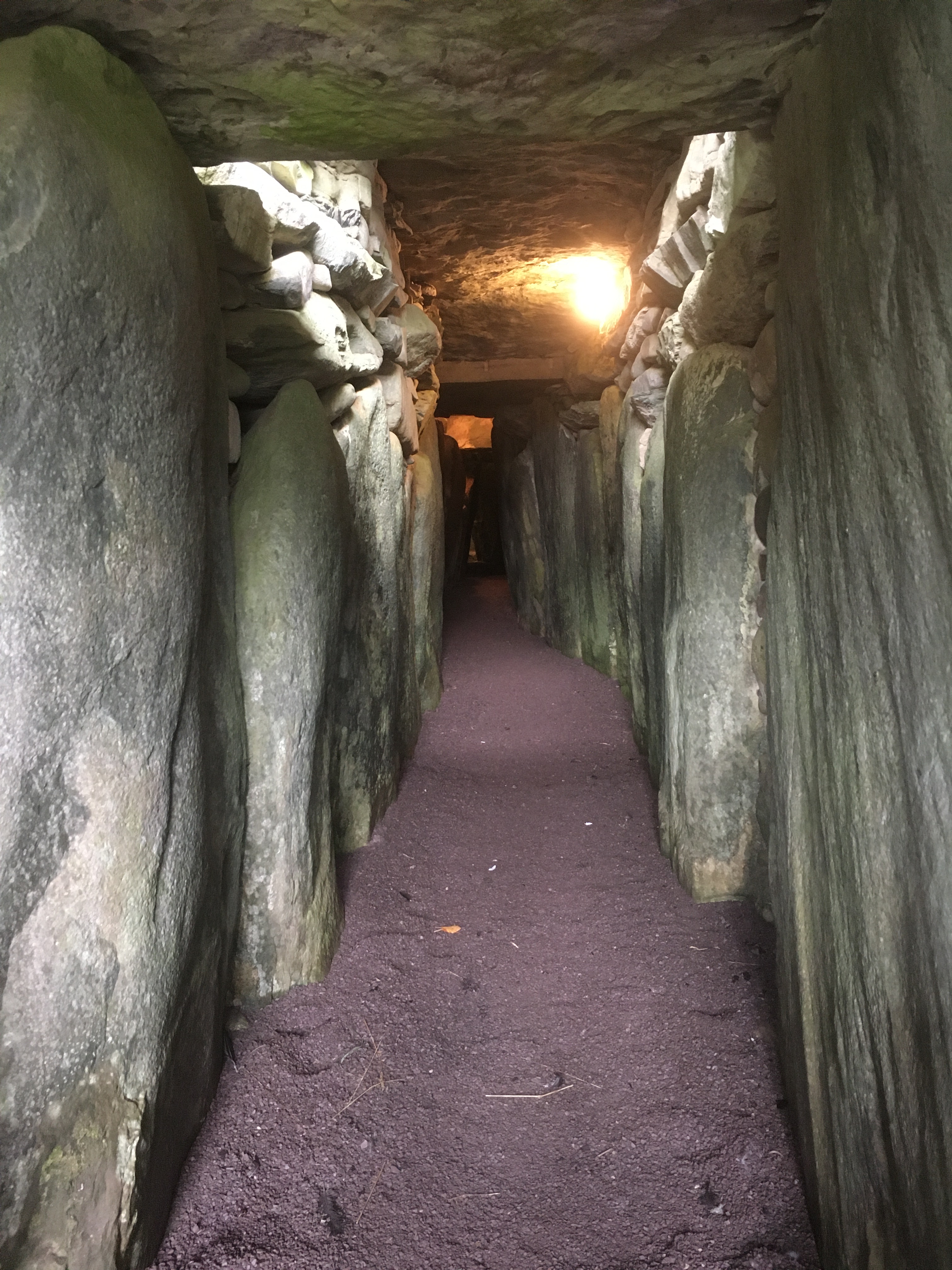
Brú Na Bóinne is a magical place any time of year. But, I suppose, it’s particularly magical around the solstice. If you get a clear day up there, it’s really special. It’s a place to let the imagination wander. You can spend a little bit of time in Fódhla-land and take a little holiday from Éiru-land!
If you can’t get to Brú Na Bóinne (and it’s unlikely that I will before the end of the year) then I’m sure there are other local spots that will do the job just fine. The important thing is to get out there and soak up the winter vibe…
Anyway, the solstice is something I always welcome each year. It marks the beginning of the climb out of the depths of winter and upwards towards the spring.
Wrap up well.
Well, that was a lot longer and more rambling than I had intended. A bit of Eastern philosophy, a dash of ‘far out’ Irish history and mythology, some etymology, a few unsolicited lifestyle tips… I hope you enjoyed it and that it makes sense to you on some level.
It is interesting where the mind can travel on the road from Galway to Scarriff…
Anyhow, winter, it was never my favourite, but I’m slowly coming around to it. I’m going to welcome the gifts it brings and enjoy it as best I can. I hope you do too.
Here’s a quote from one of my favourite winter films to finish this off…
“When Chekhov saw the long winter, he saw a winter bleak and dark and bereft of hope. Yet we know that winter is just another step in the cycle of life.
But standing here among the people of Punxsutawney and basking in the warmth of their hearths and hearts, I couldn’t imagine a better fate than a long and lustrous winter.”
Phil Connors – Groundhog Day
Crex Crex.
 The Sound Of The Corncrake